Following on from our lecture on the subject of propaganda, we were given the suggestion to analyse at face value some imagery and the articles in which it resided, before developing upon our thoughts. We were asked to do so with the techniques and devices described in the lecture in mind.
The article I refer to within the below post is titled: Dazed & Confused – Spring 2015 - Women's Fashion
Sexualisation or Contextualization?
The article I refer to within the below post is titled: Dazed & Confused – Spring 2015 - Women's Fashion
 |
| Untitled Dazed & Confused - Spring 2015 |
The images shown are created to shock and depict how in
today’s society women are highly objectified within porn. The youthful look of
the model brings to light the highly sexualised nature of the media and its
affects on the youth of today.
 |
| Untitled 2 Dazed & Confused - Spring 2015 |
The image (shown right), where she is depicted almost “drowning” upon her
bed says to me that she has begun her period and as soon as this has happened
she is being drowned in attention. I take this viewpoint from the subtle
inference implied with the red rope used within the staging. The make-up worn
by the model has been made to resemble that of a doll, you could say a china
doll which again re-enforces the objectification of women.
After reading
the article the images featured within and also an interview accompanied by
further images and a short fashion shoot video this contextualised the shoot.
However that is only in regards to the shoot as a whole or the more drastic,
extreme pieces. I still feel the two images shown within the article don’t
reflect the artists aim and ambition too well. I feel the collection “Reject
Everything” when shown as a whole, as featured in “wonderlandmagazine.com” does
reflect the no fear, brave rebellious charge of the 80’s.
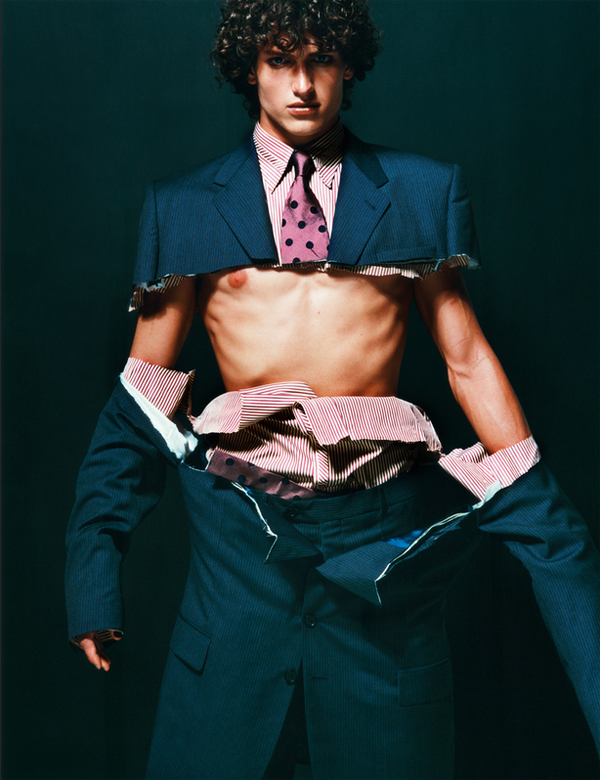 |
| Carlos Bokelman, London, V Magazine, 2000 |
I came across the following image while looking for
information about the “Reject Everything” collection. With this in mind I feel
it fits quite nicely alongside in this discussion. This image was for the spring
preview front cover of V magazine in 2001. Taken by Mario Testino, it features
model Carlos Bokelmann stood in a confident, calm posture but almost
standoffish facial expression. Looking as if he is about to earn a big pay-rise
this look is flipped with the removal of his clothing in a torn fashion.
On closer inspection from a technical point of view you can
see the arm creases don’t align with that of his upper arms. This suggests that
the clothing element to the image may have been put together in parts,
partially in the shoot and partially upon the computer. The way the suit has
been cut suggests that of someone cutting through the cloth in a fast manner,
as to create the jagged path but with a clean trim to the garment.
This image brings to mind the “ideal” representation of the
modern man, though with a hidden or in this case not so hidden, worrying
secret. Through the bombardment of mass media we constantly see photo-shopped
imagery of celebrities and this sets not only ideals for women, but more
recently so for men too. This images has what appears to be a confident young businessman
though underneath the “display” or “mask” so to speak we see he isn’t in fact
as well off as he may seem. I am not talking about money or family and friends,
but his physical and mental health; you can clearly see underneath the polished
suit he looks almost frail in physical appearance. This reflects the pressure
on society to look our best and obtain the “ideal” weight, which in this world
of doctored imagery becomes an unrealistic ideal. Rather then seeing the young
man as having a healthy body we see him spearing to be underweight, perhaps
bringing awareness to the rise in anorexia over the years.
The image also with many others taken by Testino appear in his new book named "Sir", published by Taschen. The books aim is to focus on and display the different representations of men and their fashion since the 80's and how this style has evolved.
Below are two links to articles around the book:
You can see the image used within the front cover of V magazine here: V Magazine - Issue 9
